


Views from Within: Interview with Yulia Vishnevskaya on the RFE/RL's Samizdat Archives
The Blinken OSA Archivum presents a new interview series, developed by Katerina Belenkina, featuring former Radio Liberty staff from the 1970s and 1980s who worked at Radio Liberty and were associated with the Samizdat Unit. Thanks to their efforts, the Archivum preserves the Samizdat Archives, a unique part of the Radio Free Europe/Radio Liberty Research Institute collection.
Built from materials smuggled across the Iron Curtain, this collection documents the human rights movement and human rights violations in the USSR in the second half of the twentieth century. Many of those featured in the interviews were themselves authors or distributors of samizdat before joining the Radio.
This project opens new ways of understanding and working with the collection, making its rich historical materials more accessible to researchers and the wider public.
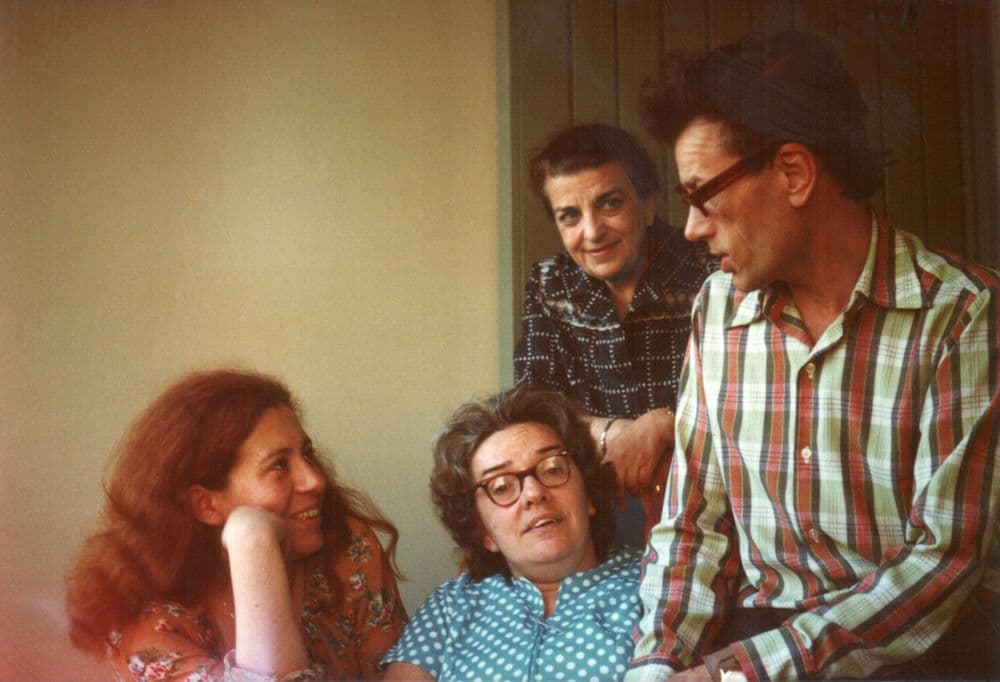
Interview with Yulia Vishnevskaya
Conducted by Katerina Belenkina
A poet and a participant in the Soviet dissident movement, Yulia Vishnevskaya was arrested multiple times. After emigrating, she worked for more than twenty years (1973–1995) in the Research Department of Radio Liberty as an analyst and journalist in the field of political science and literature.
In her youth in the USSR, Yulia was an active member of SMOG, an informal association of young nonconformist poets opposed to official Soviet poetry. She also played an active role in dissident activities, which led to three arrests, the first occurring when she was sixteen.
While working at Blinken OSA Archivum, I regularly encountered analytical texts you prepared for the Research Department. Thank you for the opportunity to shed light on how the department’s work was organized, its mission, and your specific responsibilities.
I remember my work in Radio Liberty’s Research Department with great warmth. I had a lot of affection for our department and for its head.
Munich Radio received an unprecedented amount of information, unlike anything available anywhere else in the world. We processed this material, and our English-language output was used not only by Radio Liberty and Radio Free Europe staff, but also by a wide range of Western experts working on Soviet-related issues. Their engagement gave us objective assessments of our texts, feedback on our work - through citation indexes, invitations to briefings and conferences, and similar indicators.
In what language was the information received and analyzed?
The sources came in many different languages - German, English, French, and other Western agency languages, as well as all the broadcast languages of Radio Free Europe and Radio Liberty. I don’t believe that such a volume of diverse, multilingual information had ever been available anywhere else.
But getting the information was only part of the job. You also had to know how to work with it and who to involve in that work. That’s why I remember my boss with the greatest respect and gratitude.
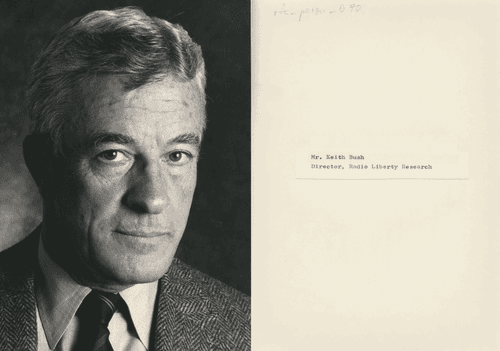
My director and the founder of the department was a British man named Keith Bush. I say "founder" deliberately, even though the department was founded before him. It was under Keith Bush's leadership that the department became a respected institution among experts in the English-speaking academic world and beyond.
(KB: Keith Bush was a Russia-watcher and director of the Research Unit of Radio Liberty from the 1970s to the early 1990s; The Research Unit has existed since the 1950s.)
Let’s take a brief pause here and return to the beginning of your story. How did you become involved in the dissident movement, and under what circumstances did you emigrate from the USSR?
I did not emigrate of my own free will; rather, I was forced to leave after the Soviet government imprisoned me in connection with the upcoming Party Congress…
It all began when I met Alek Volpin (note by K.B.: Alexander Yesenin-Volpin was a mathematician, philosopher, and dissident who was the first to formulate the idea that the state is obligated to enforce its own laws, and that citizens have the right to demand this from the state). His wife, Vika, taught at my school - the prestigious experimental School No. 711. However, by the time I met Volpin, I had already been expelled from the Komsomol for anti-Soviet agitation. When I was about twelve years old, a neighbor told me about collectivization in Ukraine, and from that moment on, my eyes were opened - I no longer believed a single word the Soviet government said.
After meeting Alek Volpin, I asked him for a copy of Civic Appeal. I was planning to attend the Glasnost Rally - it is thought that this was the event where the dissident movement began.
(K.B.: In 1965, A. Yesenin-Volpin was one of the organizers of the Glasnost meeting held in protest against the arrests of writers Andrei Sinyavsky and Yulii Daniel. For the meeting, Yesenin-Volpin prepared a leaflet, Civic Appeal, urging people to attend on December 5, 1965, and demand a public trial for those arrested.)
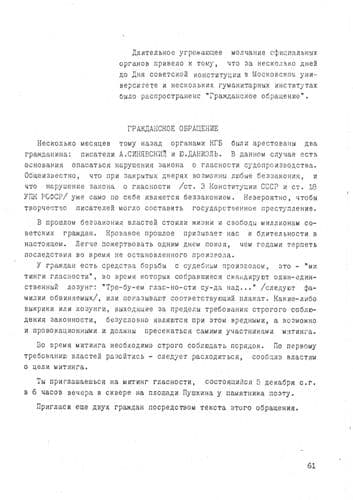
I didn’t make it to the meeting. The KGB came to my school and took me away for interrogation. After this they put me in a mental hospital - in the children’s ward. They couldn’t open a formal case since at the time there were no laws prohibiting the meeting. When I refused to reveal who had written the Civic Appeal leaflet, they were offended although I suspect they already knew perfectly well who the author was. They kept me in the psychiatric ward for a month.
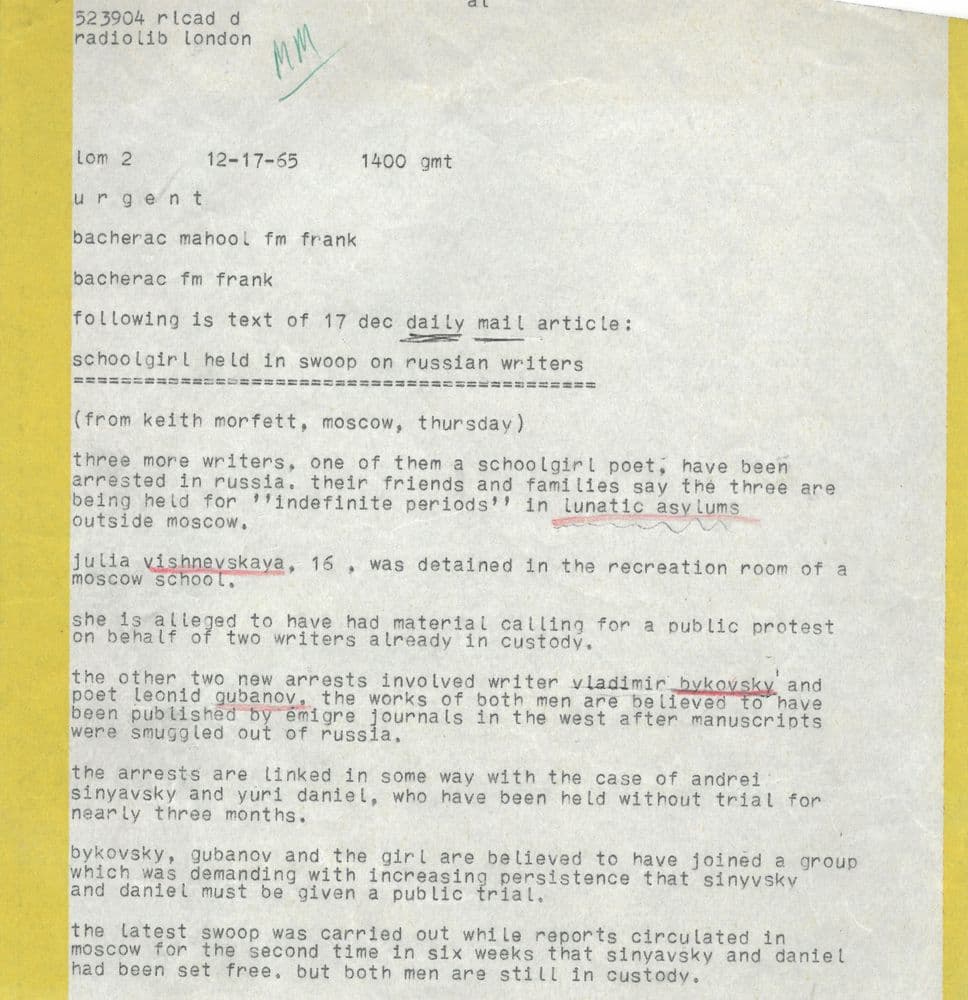
I never went back to my regular school; instead, I completed my studies at an evening school. After that, I enrolled in the editing department at the Plekhanov Institute.
I was arrested for the second time in 1970 for resisting a police officer, Kichkin, during the trial of Natalya Gorbanevskaya. He began to drag away an elderly woman - Olga Ioffe’s mother (Olga facing the same insanity hearing as Gorbanevskaya). The woman had been standing by a window in the courthouse courtyard, trying to hear what was happening, when Kichkin started pulling her away. People were outraged and rushed to defend her. We were arrested and held at the Serbsky Center, but the case was eventually dropped, and we were released.
Descriptions of the circumstances of Yulia Vishnevskaya's arrest during Natalia Gorbanevskaya's trial. July 10, 1970. AS 498 (HU OSA 300-85-9:13/8):
The last time I was arrested was on the eve of the 24th Congress of the CPSU in 1971. After that, I was forced to leave.
Even though I was the only non-Zionist in our family, I was the first to leave for Israel. I didn’t want to go, but my parents insisted - they said they couldn’t bear it any longer. My friends also urged me to leave, including Alek Volpin, who was especially respected by me, and who said: “There’s no need for you to sit in prison during all their congresses, conferences, and other gatherings. Just go ahead and leave!”
It so happened that I was among the first to leave, shortly after the authorities began letting people leave the USSR a few at a time - on November 5, 1971. Once in Israel, I enrolled in the Department of Library Science at the Hebrew University of Jerusalem.
At some point, I received an offer from Radio Liberty and, without completing my degree, moved to Munich. Many years later, I learned that it was CIA agent Max Ralis who had put my name forward. (KB: Max Ralis was one of the heads of Radio Liberty’s Audience Research Department.)
Max Ralis had come to Israel to meet the new arrivals from the USSR, with the intention of recommending some of them for positions at Radio Liberty.
In other words, I was not seeking this job at the time. I simply received the invitation and was delighted to accept it. Joining Radio Liberty was a great stroke of luck.
How was the work in the Research Department organized? What were your responsibilities?
When I joined Radio Liberty, the Research Department was already in place. At that time, there were two separate radio stations - Radio Free Europe and Radio Liberty - each with its own Research department. Later, they merged. (KB: In 1976, RFE and RL merged into Radio Free Europe/Radio Liberty (RFE/RL))
Some people believed the merger was a good decision (including Keith Bush), while others thought it was a mistake. In any case, the merger led to several reorganizations. However, I was not involved in those changes.
I worked on the USSR. When I first joined the Radio, I was supposed to assist Alya Fedoseeva with the Collection of Samizdat Documents series, Sobranie Dokumentov Samizdata. However, that work soon tapered off, and the series was discontinued.
Next to our department, there was a Samizdat Unit- “in two different guises,” as my colleagues put it. That is, there were Peter Dornan’s unit and Albert Boyter’s unit, which largely overlapped. Later, the overlap was eliminated, leaving only Dornan’s department, which focused on the Materialy Samizdata series.
While working in the Research Department, I covered dissidents and samizdat, often alongside Peter Dornan’s Unit. Our units maintained good relations, but we operated quite separately. (illustrative photo of a planning meeting). Sometimes we helped each other. Garik (Gabriel) Superfin had a truly unique talent for archival research. You could spend the whole day searching for materials, and Garik would instantly uncover more than anyone else could find. (KB: Gabriel Superfin - editor of the human rights bulletin Chronicle of Current Events; arrested in 1973 and sentenced to five years in a labor camp and two years’ exile for “anti-Soviet agitation and propaganda.” After emigrating to Germany, he worked in the Samizdat Unit of Radio Liberty (1984–1994) and as an archivist at the Institute for East European Studies at the University of Bremen (1995–2009)).
Tell us about the colleagues who worked with you in the department.
Elizabeth Teague was a general political scientist; Ann Sheehy was a specialist in Central Asia (she taught me a lot; for example, how to write a research paper: “The main point you want to make should appear at the beginning of the text.”), Petr (Anatolii) Kruzhin, with whom I had coffee every morning, worked on military issues; and Sergei Voronitsyn. I also brought Vera Tolts to our department; now she is a professor at the University of Manchester.
My immediate supervisor after Albert Boyter was Elizabeth von Doemming.
Am I right in understanding that you ended up in the section of the Research Department that continued working on dissidents and human rights violations, even though by then this topic had largely been taken over by the Samizdat Unit?
Dornan’s Samizdat Unit published Samizdat itself. They were not responsible for the descriptive section. Our department, including me, handled the analysis.
What else did I do? Because of my deep love for literature, I wrote extensively about literary matters. Then, when Perestroika began, I became interested in politics, because I was among the first to sense that this wasn’t just another thaw, but something far more serious. I was impressed by the way Mikhail Sergeyevich Gorbachev casually nudged the Defense Minister on the podium at the Mausoleum. I had no doubt even then about where things were heading.
When the publications began, I was completely stunned - books that would previously have landed people in jail were now being published! That was a sign. I couldn’t have imagined back then that the Soviet Union would collapse, that it would go so far. I’m no prophet, but I understood from the very beginning that things were moving in the right direction. At least, in the direction I needed them to go.
I was one of the first to realize that Perestroika would go far, because in those days it wasn’t customary to trust.
And when the General Secretary of the CPSU began quoting samizdat texts in his speeches, that was already an act of sedition - Volpin’s ideas about authority and legality, then the letter from Sakharov, Turchin, and Medvedev, almost verbatim. Suddenly, you recognize your own ideas - the ones you grew up with - in Gorbachev’s speeches. And then the prisoners were released, and Memorial Society was founded.
I've come across your texts in our collection many times. They provide descriptions and analyses on a wide range of topics, supported by extensive references to primary sources. Did you formulate the topics and format of these reports yourself?
It all began when Alexander Isaevich Solzhenitsyn was expelled from the USSR and published a collection of essays titled From Under the Rubble.
The first person I wrote about in this context was Grigory Pomerants.
The text was very well received - not only by people in our department but also by the Russian Service. After that, I continued working on similar topics.
Were you required to do archival research and how was the information verified?
For my work, I occasionally conducted personal archival research, but I mainly relied on the Red Archive for publicly accessible materials.
There was also the Monitoring Unit, separate from the Research Department - it functioned as an independent service. They monitored radio broadcasts and printed out the most important information.
As for verifying information, the rule was to have two independent sources - three was even better. I generally knew what was true and what was false.
How was the mission of Radio Liberty’s Research Department defined?
In theory, we existed as an information source for the radio editorial service. In reality, however, the Russian editorial staff didn’t really need it, unlike the Czech or Polish services. Our work was useful when they were interested in what was happening in the Soviet Union. In a broader sense, it probably made sense. But for the Russian Service, English-language texts weren’t particularly necessary, since there were already plenty of Russian-language sources available.
Personally, I never had any problems with the Russian Service. My difficulties were entirely different: I couldn’t speak or read into a microphone, which I had to do quite often.
How did you choose the topics? What language did you write in?
I mostly chose the topics myself. Occasionally, I was asked to write about a particular person, and sometimes I refused. For example, I was once asked to write an obituary for Sakharov - while he was still alive, not when he was actually dying, but when he was being force-fed (KB: referring to the period of Sakharov’s exile in Gorky, when he went on hunger strike demanding that his wife be allowed to leave the country for medical treatment). I told them it is not a good sign and refused to write it - and I was right to do so.
I wrote in both Russian and English, though my English always required editing.
Can you recall a memorable moment while working in the Research Department when you suddenly found yourself holding a particularly important document?
I remember, rather, the opposite, how we were missing something. The Samizdat Archive, and Radio Liberty generally, did not include the versions of Yeltsin’s speech at the CPSU Central Committee Plenum - the speech that launched his career that was circulating in Moscow and later turned out to be false. In that speech, he allegedly mentioned Raisa Gorbacheva. This version was fabricated by M. Poltoranin and circulated throughout the Soviet Union, or at least across the Russian Federation. Yet for some reason, the document never made its way into our Samizdat Archive, which struck me as significant.


