


Urban Spaces of Engagement, Dialogue and Memory: The Association ADOPT Srebrenica and its Documentation Center - Guest Lecture at the Archivum

The wars in Bosnia and Herzegovina (1992–1995), particularly the Srebrenica genocide, caused profound human and material loss, social division, and the destruction of personal and cultural memory. In the aftermath, Srebrenica became marked by trauma, silence, and broken community ties, leaving younger generations disconnected from their past.
In response, ADOPT Srebrenica was founded in 2005 as an informal platform for exchanging ideas, as an initiative to rebuild trust and encourage dialogue within the divided community. From this effort, the Documentation Center emerged as an unconventional, “living archive” that evolves with its community, collecting, preserving, and sharing personal and official materials like photographs and other documents of prewar life in Srebrenica.
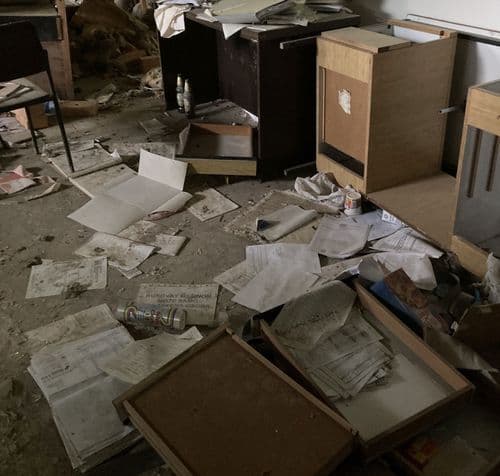
The Documentation Center gathers these materials through sensitive and empathic work with families of victims and survivors, and field research, rescuing items that might otherwise perish from abandoned factories, schools, and family homes—urban archaeology of sorts. Beyond archiving, it has a social role: helping individuals reconnect with their personal histories and rebuild a sense of identity, often through small but meaningful fragments.
Overall, both ADOPT Srebrenica and its Documentation Center through its archiving activity aim to restore community bonds and preserve memory, using dialogue and shared history as a foundation for healing and the future.
Bekir Halilović
Bekir Halilović attended the Srebrenica Gymnasium and later enrolled at the Faculty of Law, University of East Sarajevo, where he is currently finishing his studies. He has been involved with the Association ADOPT Srebrenica, and especially the development and work of its Documentation Center since 2014. He currently serves as chief archivist and coordinator. He is also the president of the assembly of ADOPT Srebrenica.
Bekir is directly engaged in the collection, processing, and systematization of archival materials related to prewar life in Srebrenica. His work includes field research, cooperation with families and donors, as well as developing and maintaining the archival management system. He actively participates in the Association’s public programs and is a co-author of publications and brochures on the work of the Documentation Center.
Valentina Gagić
Valentina Gagić is one of the founders and the current president of the board of the Association ADOPT Srebrenica, as well as a dedicated contributor to the development of its Documentation Center.
An activist in peacebuilding and supporting vulnerable people, Valentina initiated and participated in successful cooperations in the Srebrenica Municipality, as well as all over Bosnia and Herzegovina, focusing mostly on community building and harmonious interpersonal relations. In these endeavors, she chooses to speak and stand up to political and other societal anomalies rooted in dominating the other and in endangering interethnic relations.
Valentina believes in the good and preserves the integrity that defines her – to speak what she thinks, and to do what she speaks of.


