

CfP: Collecting/Creating
The conference Collecting/Creating: Archive-Based Moving Image in Eastern Europe and Beyond, on October 8-9, 2026, will examine how artists and archivists mobilise visual media to reanimate the archive, and whether thinking in terms of a distinct Eastern European archive-based art is productive. Deadline for submitting proposals for individual 20-minute presentations as well as for full panels and workshops is June 19.
The archive has emerged as one of the most productive, cross-disciplinary frameworks for understanding contemporary media ecology. It operates as a site of collection and preservation, and also as a generative stimulus to creative artistic practice within a rapidly transforming media landscape. While the “image” in the digital age is often characterised by its fundamental processuality – accessible, malleable, and endlessly reproducible – the archive continues to signal questions of materiality, institutional authority, and ideological charge. If the archive “presents itself as the ultimate horizon of experience” (Callahan 2022), how does this horizon operate for artists working within precarious archival infrastructures? How can artists negotiate the potentials and limits of the archive across different geopolitical and institutional contexts in Eastern Europe and beyond?
This conference seeks to examine how artists and archivists mobilise visual media (ranging from state-produced visuals to home movies and family photographs) to reanimate the archive. It asks whether thinking in terms of a distinct Eastern European archive-based art is productive, and if so, how this perspective might help reveal the particular conditions, practices, and creative interventions that shape engagement with archival materials in precarious contexts.
This conference seeks to examine how artists and archivists mobilise visual media (ranging from state-produced visuals to home movies and family photographs) to reanimate the archive. It asks whether thinking in terms of a distinct Eastern European archive-based art is productive, and if so, how this perspective might help reveal the particular conditions, practices, and creative interventions that shape engagement with archival materials in precarious contexts.Post-cinematic media contribute “in actively re-shaping our inherited cultural forms, our established forms of subjectivity, and our embodied sensibilities” (Shaviro 2024), which compel us to reconsider the recent shifts in cultural logics and practices of producing, processing, and circulating images. While archive-based artwork– including installation, found footage film, soundscape, performance, and digital interfaces – has been widely discussed for its formal elements and its ability to bring forward marginalised histories, significantly less attention has been paid to the intermedial aspects, ”the possible relations of transformation, transgression, and negotiation of media borders” (Grishakova 2024). This conference strives to position artistic engagement with the archive within the new sensuality of the emerging digital landscape, which redefines the intermedial and cultural-economic conditions of the artistic and vernacular processing of audiovisual heritage, and underscores the intertwined labour of artists and archivists in shaping what can be seen and reimagined.
In conjunction with the conference, a special screening by Hungarian media artist Péter Forgács and a public conversation with the artist will offer an opportunity to reflect on the practical and conceptual dimensions of archive-based art. While the conference aims to explore archive-driven artistic practices from an international perspective, this event highlights Forgács’s work as a significant point of reference within the broader landscape of media art. We particularly welcome contributions that place his practice in dialogue with other artistic and archival traditions, especially from Central and Eastern Europe and beyond, in order to foster comparative and transnational perspectives on the uses of archives in contemporary art.
Keynote: Oksana Sarkisova (Blinken OSA Archivum/Central European University)
Topics to discuss and analyse archive-based intermedial works may include, but are certainly not limited to:
- Collecting and creating in the post-cinematic age
- Dialogues between the archive and research-based art practice
- Digitization and the transformation of archival labour
- Eastern European archival ecologies in transnational perspective
- Comparative perspective on audiovisual archives in precarious contexts Archiving, selection, and ethics in artistic and curatorial practice
- Transnational perspectives on archive-based art from Eastern Europe
- Works of Péter Forgács in the cross-section of media art, home movie heritage, and other artistic practices
- Comparative analysis of found footage films reworking public and private archives
- Remediation and intermediality in archive-based moving image
- Archive-based moving image and exhibition contexts: museums, galleries, festivals, and online spaces
- Materiality, instability, and the sensory dimensions of archives
Call for Papers: We welcome submissions for individual twenty-minute presentations as well as for full panels and workshops. Proposals should be no more than 300 words, accompanied by an indicative bibliography and a brief third-person biography. Please send your proposals by filling in this form: SUBMISSION FORM
Deadline: June 19, 2026. We aim to notify you about our decisions regarding the proposals by: July 3, 2026.
In case you have any questions, contact us at: collectingcreating@gmail.com
Organising institutions: Hungarian Society for Film Studies (MFT) and the Institute for Advanced Study, Central European University (Budapest).
Partners: Blinken OSA Archivum. Participants of the conference will be invited to a special guided tour of the archive.
The conference program will be announced at a later date.
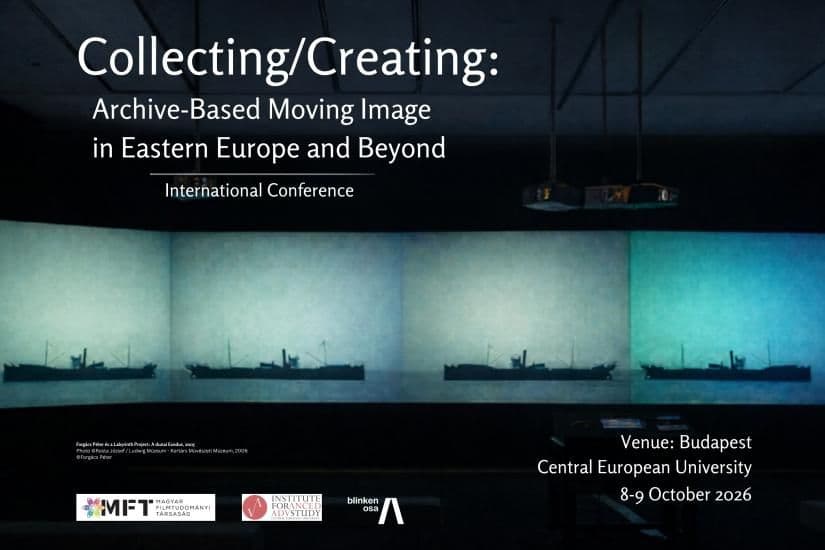
Image: Péter Forgács and the Labyrinth Project: The Danube Exodus, 2005 ©Rosta József / Ludwig Museum - Museum of Contemporary Art, 2006 ©Forgács Péter


